
At a glance
Diagnosis: Triple positive breast cancer (ER+, PR+, HER2+)
Drug regimen: TCHP chemotherapy (six rounds) followed by lumpectomy, HER2-targeted therapy, radiation and hormone blockers
Cold capping results: Approximately 70% hair retention with Penguin Cold Caps
Erin says: “Keeping my hair helped preserve a sense of identity and normalcy during one of the hardest seasons of my life.”
At 43, Erin was living a full and busy life in Texas as a nurse practitioner, wife and mother of three. Her world revolved around caring for others, supporting patients through their health challenges, raising her children and nurturing her faith and community.

Erin retained around 70% of her hair during chemotherapy with Penguin Cold Caps.
Cancer was something she had helped others navigate professionally, but never imagined facing herself. That changed in September 2025, when Erin felt a lump.
“I was diagnosed with triple positive breast cancer — ER+, PR+, HER2+,” she explains. Like many diagnoses, it began with a simple moment of instinct. “I felt a lump, and imaging confirmed what I feared.”
Suddenly, the woman who had spent years caring for patients found herself stepping into the unfamiliar role of one. “My life has always centered around caring for others, both at home and in my work, so stepping into the role of ‘patient’ was a profound shift.”
The fears that came first
The first emotions Erin felt after diagnosis were stark and immediate. “My first fear was death,” she says honestly.
But almost as quickly, another concern took hold: how her illness might affect her children. “As a mother, I have always tried to shield them from life’s hardest realities. Now I was facing something I could not hide.”
“I didn’t want their childhood to be marked by their mother’s battle with cancer,” she explains.
During those early weeks of treatment planning, she realised that keeping her hair could help preserve some sense of normal life at home.
“I didn’t want my children to think about cancer every time they looked at me,” Erin says. “If I could preserve even one layer of normalcy for them, it felt worth fighting for.”
Searching for the right cold capping option
Erin’s medical team mentioned scalp cooling early in the process, although the information they gave me wasn’t particularly encouraging. “My doctor’s office told me about cold capping, but they were skeptical,” she recalls. “They explained to me that it only works in a handful of people.”
Her treatment centre offered a machine-based scalp cooling system, but Erin and her family decided to research the options more thoroughly.
“Once we started researching, we realised that the scalp cooling system offered didn’t seem to have strong success rates for the chemotherapy regimen I was receiving,” Erin says.
Her treatment plan included six rounds of TCHP chemotherapy, a regimen known to cause significant hair loss.
“After reading the success rates and hearing stories from other women, we chose Penguin Cold Caps.”
A last-minute decision
The decision to cold cap came at the very last minute — just days before Erin’s first chemotherapy treatment. “We made the decision late on a Friday evening, and my first chemotherapy treatment was Monday morning,” Erin says.
With the weekend approaching and very little time to prepare, Erin’s husband immediately stepped in to make it happen. “My husband took over ordering and coordinating everything so we could move quickly.”
Despite the tight timeline, Penguin Cold Caps was able to arrange everything over the weekend so Erin could begin cold capping at her very first treatment.
The “Save the Hair Team”
As treatment approached, Erin’s family and friends rallied around her in a remarkable way. “My husband, sisters and dear friends formed what we called the ‘Save the Hair Team,’” she says.
They learned the cold capping process together and committed to supporting Erin throughout every chemotherapy session.“They didn’t leave my side for eight and a half hours at each treatment.”
Cold capping requires caps to be changed regularly to keep the scalp at the correct temperature, so having a dedicated support team can make a huge difference.
“They knew it mattered to me, so it became important to them,” Erin says. “I felt deeply loved and supported.”
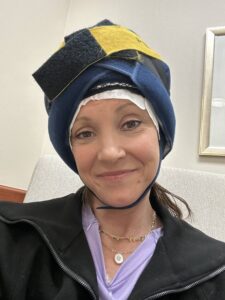
Erin during chemotherapy treatment using Penguin Cold Caps.
The reality of cold capping
Like many Penguin Cold Caps users, Erin found the beginning of each session the most challenging. “The first three caps were the hardest – about the first hour,” she says.
“The cold was COLD.” But once she moved past that initial phase, it became much more manageable.
“After that first hour, it became tolerable,” Erin explains. “Once I completed the first treatment, I knew what to expect and felt mentally stronger going into the remaining sessions.”
One small comfort made a big difference. “A very heavy, warm blanket became my best friend during treatment days.”
Watching the shedding
Before treatment began, Erin had fairly thick hair. She knew that some shedding was likely, even with cold capping. “After nearly every shower I noticed some hair loss,” she says. “It was emotional.”
But she stayed committed to the process, “I kept trusting it.”
In the end, the results were better than she expected. “Overall, I think I lost about 30% of my hair, so I kept around 70%.”
The gift of normalcy
For Erin, keeping her hair had a powerful emotional impact during treatment. “It allowed me, at times, to forget the battle I was walking through over those six months,” she says.
Just as importantly, it helped her children experience life with fewer visible reminders of cancer. “It allowed my children and family to experience moments of normalcy.”
She could attend school events and family activities without immediately drawing attention or sympathy. “I could go to my children’s events without turning heads or drawing immediate pity,” Erin says. “I could have conversations that didn’t revolve around cancer.”
That sense of normalcy meant everything. “It meant more to me than I can fully describe,” adds Erin.
Erin’s advice for others considering cold caps
Cold capping does require commitment, Erin says. It takes time, planning and energy – particularly during an already demanding treatment schedule.
“It requires time, effort, money and energy,” she explains, “but for me it was absolutely worth it.”
At the same time, she recognises that every cancer journey is deeply personal. “I deeply respect that this is a very personal decision, just like every part of the cancer journey is personal. Each person must decide what matters most to them during treatment.”
“For me, preserving my hair helped preserve a sense of identity during one of the hardest seasons of my life,” she says. “And I’m grateful beyond words that it was an option.”
Get in touch
If you’re about to undergo chemotherapy and want to find out more about cold capping, why not request a call back? Our reps can provide more information, and answer all of your questions.
Just click here, complete the callback form and your local rep will be in touch.