
At a glance
Diagnosis: Invasive lobular breast cancer
Drug regimen: AC chemotherapy (four rounds, every two weeks) followed by 12 weekly rounds of Taxol
Cold capping results: 95% hair retention with Penguin Cold Caps
Dana says: “Keeping my hair helped me stay positive and made going through treatment so much easier.”
Married for 37 years, with two adult children and a demanding career as an executive sales representative in the education technology sector, Dana thrived on staying active. Running or walking three to five miles a day was simply part of her routine.

Dana surrounded by family
Then, in May 2025, everything changed.
“I was diagnosed with invasive lobular breast cancer,” Dana says. The news came despite decades of vigilance. “I’d had a mammogram every year for the past 30 years.”
She began treatment in California, facing a rigorous chemotherapy plan: four rounds of AC followed by 12 weeks of Taxol.
The fear that hit hardest
Dana is direct about what scared her most. “Honestly, besides dying, which wasn’t an option, my biggest fear was losing my hair.”
For her, it wasn’t about vanity. It was about control, identity, and how she moved through the world. “I didn’t want people to know I was going through cancer treatment,” she explains. “I felt fine, and I wanted to go about my life without being identified as a cancer patient.”
Just as important was the impact on those closest to her. “I wanted my family to feel like things were normal too.”
Discovering cold capping
Cold capping wasn’t new to Dana. “Years ago, I met a woman going through breast cancer treatment who was cold capping, and she kept most of her hair,” she says. More recently, a friend’s mother had gone through a similar experience with even stronger results.
“So when I was diagnosed, I already knew it was something I wanted to try.”
When she raised it with her oncologist, the recommendation was clear. “He told me Penguin Cold Caps was the best option,” Dana says. Her treatment center, St. Joseph’s infusion center in Orange, California, supported that choice.
A process she could handle
Dana describes the cold capping process in practical terms – not easy, but manageable. “It was very tolerable,” she says.
Like most patients, the first few minutes were the hardest. “The first 10 to 15 minutes of the initial cap were always the coldest.”
But once she understood the limits, her mindset shifted. “I remember asking my capper on my first day, ‘Is it going to get any colder than this?’ When she said no, I knew I could do it.”
That moment mattered. It turned uncertainty into something she could handle.
Krystal, Dana’s Penguin Cold Cap capper, sees this moment often. “As a capper, my role is not just technical,” she explains. “It’s about helping patients feel comfortable and supported so they can get through those first few minutes and realise they can do it.”

Dana with Krystal
The power of expert support
Dana credits a huge part of her success to having professional support throughout her treatment. “I was very fortunate to have Krystal for all of my sessions,” she says.
Behind the scenes, that support is highly structured. “The caps have to be fitted correctly, maintained at the right temperature, and changed at precise intervals,” Krystal explains. “Consistency is everything.”
For Dana, that translated into confidence. “Making sure the cap is fitted correctly is everything,” Dana explains. “If it’s not, the process can be much less tolerable.”
“Dana approached the process with a calm and positive attitude from the first session,” says Krystal. “She was very receptive to guidance, and that makes a real difference to the results.”
Discipline made the difference
If there’s one thing Dana is clear on, it’s this: results don’t happen by accident. “You have to follow the directions exactly,” she says.
She stuck closely to the routine set by Krystal, from washing schedules to daily hair care.
- Washing her hair only when instructed
- Using cold water with minimal pressure
- Avoiding all heat styling
- Gently combing twice a day with a wide-tooth comb
- Leaving her hair down at all times
- Avoiding hats, scarves, or wigs
“Krystal gave me a very strict set of guidelines, and I followed them from day one,” Dana says.
From a clinical perspective, that discipline is non-negotiable. “Success comes down to consistency and following the protocol,” Krystal says. “The cap must stay cold, fit securely, and patients need to follow the hair care guidance throughout.”
Managing shedding
Dana did experience some hair loss, particularly early on. “Yes, there was shedding, mostly on the days I washed my hair,” she says.
But she noticed something encouraging as treatment progressed. “Toward the end of the Taxol treatments, the shedding seemed to lessen.”
Crucially, the overall result still allowed her to maintain her appearance, and her sense of normalcy.
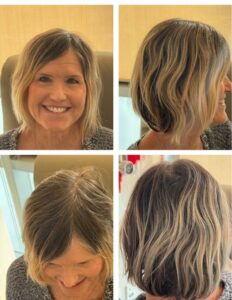
Dana retained around 95% of her hair
Strong results that exceeded expectations
Dana’s results went far beyond what many people expect from chemotherapy.
“I kept about 95% of my hair,” she says.
Before treatment began, she had been told to expect significant hair loss, particularly during the AC phase, which is widely known for causing it. “But that wasn’t my experience,” she explains.
While Dana did experience some shedding, especially on wash days, it never progressed to visible thinning or patchy loss. “No one could tell I was going through treatment,” she says.
She maintained her appearance throughout both phases of chemotherapy, including the more aggressive AC portion, with no bald spots and consistent coverage. By the end of treatment, shedding had reduced and her hair remained strong.
That result gave her something even more important: the ability to keep living her life on her own terms. “I wanted to go about my life every day during treatment without being identified as a cancer patient,” she says.
She continued working, exercising, and showing up as herself, not as someone defined by illness. “Keeping my hair helped me stay positive,” Dana explains. “And it made going through treatment much easier.”
Krystal sees the wider impact of results like this every day.
“For many patients, keeping their hair helps maintain a sense of normalcy and identity,” she explains. “It gives them a feeling of control at a time when so much feels uncertain.”
Looking back
Dana has no hesitation when it comes to recommending cold capping. “I would highly recommend Penguin Cold Caps to anyone concerned about losing their hair during treatment,” she says.
Krystal’s advice is equally direct:
“Stay committed to the process and follow the protocols. With the right support and consistency, cold capping can be a meaningful option.”
For Dana, it wasn’t just about appearance. It was about mindset, resilience, and maintaining control during a time when so much felt uncertain.
Get in touch
If you’re preparing for chemotherapy and want to find out more about cold capping, Penguin Cold Caps can help you understand your options and what to expect.
Requst a call back to speak with a local representative and get personalized guidance for your treatment plan.
Just click here, complete the callback form and your local rep will be in touch.