
At a glance
Diagnosis: Low-grade endometrial adenocarcinoma
Drug regimen: Carboplatin and Paclitaxel chemotherapy (six rounds), following hysterectomy and radiation
Cold capping results: Approximately 60–70% hair retention with Penguin Cold Caps
Susan says: “Being able to look in the mirror and not look sick helped me more than I can explain.”
At 52, Susan was enjoying a full and happy life – with a successful real estate career, three grown children, and nearly 30 years of marriage behind her.

Susan’s hair six months after treatment, showing strong regrowth and retention.
Cancer wasn’t part of the plan.
That changed in March 2025. “I was diagnosed with low-grade endometrial adenocarcinoma,” Susan says. Just weeks later, she underwent a full robotic hysterectomy. What doctors discovered during surgery shifted everything. “It had spread further than anticipated, so chemotherapy and radiation were recommended.”
Suddenly, Susan was facing six rounds of Carboplatin and Paclitaxel chemotherapy, and all the uncertainty that comes with it.
The moment everything felt real
When Susan learned she needed chemotherapy, the emotional impact was immediate. “I was devastated,” she says. “But I understood why, and I was going to do everything possible to prevent a recurrence.”
Like many women, one question surfaced almost instantly: Would she lose her hair?
“My doctor mentioned something called cold capping. I had never heard of it,” Susan recalls. It was her daughter who dug deeper. “She came back and said, ‘Mom, it’s really a thing.’”
That moment shifted Susan’s mindset. “I decided I was going to try it. I wanted to do anything I could to maintain some sense of normalcy while going through treatment.”
Choosing Penguin Cold Caps
Once Susan started researching, one option stood out. “We chose Penguin because they have the highest success rate,” she says. “And I found a local representative who had been treated at the same facility I was.”
That combination of proven results and real, lived experience gave her confidence at a time when control felt limited.
A demanding commitment
Susan doesn’t sugarcoat the reality of cold capping. “It’s a very demanding process,” she says plainly.
The early stages of each session were the toughest. “The first couple of caps were very cold and painful. But after that, it got easier.”

Susan wearing a cold cap during treatment to help reduce chemotherapy-related hair loss.
What made the difference was support. “My husband was my savior,” she says. “He was with me for every treatment and became a pro at switching the caps, managing the cooler and handling the dry ice.”
Together, they built a routine – preparing the night before, packing everything carefully, and following the process step by step.
Susan followed the recommended techniques closely, using panty liners, cheesecloth and a hairnet to secure the caps, along with pads to protect her ears.
“I never had any issues with frostbite,” she adds. “I’m so extremely thankful I decided to give it a try.”
The reality of hair loss
Before treatment, Susan had thick hair. She knew she wouldn’t keep all of it, but she hoped to keep enough.
“I probably lost about 30 to 40%,” she says. “But no one knew I was going through treatment.”
There were difficult moments. “About 14 days after each treatment, I had heavy shedding. And then there was continuous shedding every day, especially after washing my hair.”
It would have been easy to give up. She didn’t.
Holding on to normal
For Susan, cold capping wasn’t about vanity. It was about identity and control. “It helped me maintain a sense of normalcy, which helped me mentally,” she explains.
That impact went deeper than appearances. “Keeping positive and upbeat is hard during treatment. But being able to look in the mirror and not look sick helped tremendously.”
It also gave her something she valued deeply: privacy. “I didn’t want people to see me as being sick,” Susan says. “I didn’t want anyone knowing what I was going through until I was ready to share.”
Cold capping gave her that choice.
A deeply personal decision
Susan is clear about one thing: cold capping isn’t for everyone. “Some people don’t mind losing their hair,” she says. “But for me, it’s what literally helped me leave the house every day.”
If the process doesn’t matter enough to you, you won’t stick with it. And if you don’t stick with it, it won’t work.
Susan committed fully, and that’s why she saw results.
What helped along the way
Susan approached cold capping with discipline.
She washed her hair just twice a week, always in cold water. She combed it gently twice a day and kept it down. She switched to satin pillowcases and avoided overheating her scalp, even during summer treatments.
On the hardest days, she managed her mindset as much as her routine. “On heavy shedding days, I tried not to feel discouraged,” she says.
She avoided cutting or coloring her hair during treatment, waiting 12 weeks before using a gentle box dye, and only later returning to the salon.
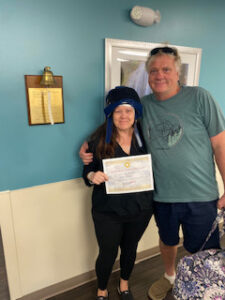
Susan marks the end of chemotherapy with her husband after completing treatment.
Life after treatment
Now, six months after her final chemotherapy session, Susan’s hair is recovering well.
“It’s healthy and strong, with very minimal shedding,” she says. “I do have some regrowth around my hairline and underneath, but overall, I never had bald spots.”
That outcome: not perfection, but preservation – and that’s exactly what cold capping is designed to deliver.
Looking back
If there’s one thing Susan wishes, it’s that cold capping was easier to access. “The hardest part is that it’s manual and you need someone to help you,” she says. “Not everyone has that.”
She knows how lucky she was to have her husband there every step of the way.
And she’s now determined to pay that support forward.
“I’ll always share my story,” Susan says. “Cold capping was such a huge part of my journey, and I want to help others if I can.”
Get in touch
If you’re about to undergo chemotherapy and want to find out more about cold capping, why not request a call back? Our reps can provide more information, and answer all of your questions.
Just click here, complete the callback form and your local rep will be in touch.